Peptide Stability and Degradation: Oxidation, Deamidation and Aggregation
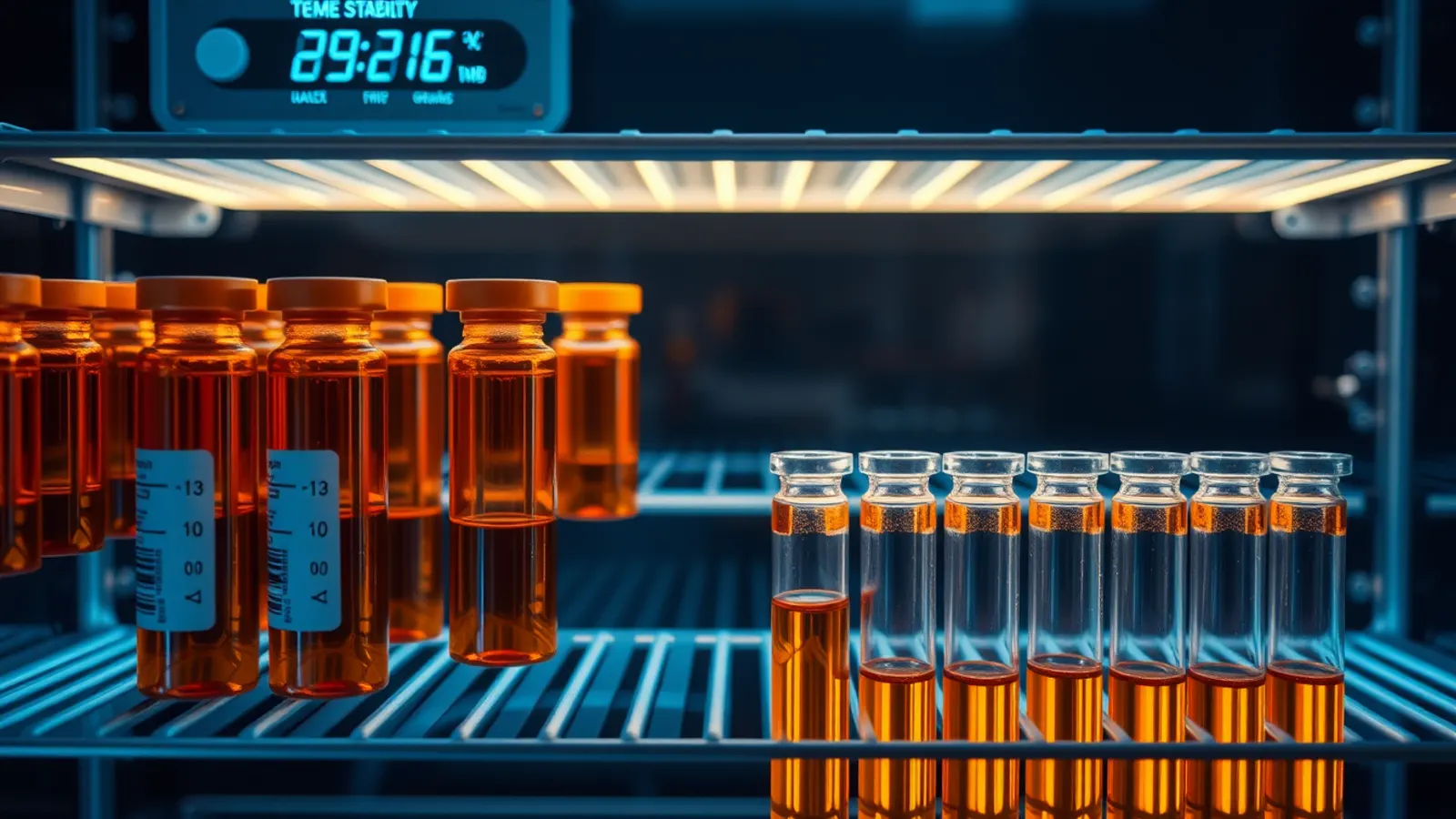
Peptide stability is not a fixed property of a sequence. It is the outcome of a set of chemical and physical reactions that proceed at rates governed by temperature, moisture, pH, oxygen and light. Some residues are much more vulnerable than others, and the products of peptide degradation are predictable enough that a laboratory can recognise them by their chromatographic behaviour and their mass. This guide explains the main pathways, what accelerates them, and how they appear in the analytical data on a certificate.
Chemical and physical instability
Reviews of protein and peptide stability divide degradation into two families (Manning et al., 1989; Manning et al., 2010):
- Chemical instability: covalent changes that create a new molecule, such as oxidation, deamidation, hydrolysis, isomerisation and racemisation.
- Physical instability: changes in structure or state without new covalent bonds, such as aggregation, precipitation and adsorption to surfaces.
Small linear peptides have little higher-order structure to lose, so for most research peptides chemical pathways dominate. Physical pathways become more important for longer, more hydrophobic or amyloid-prone sequences.
Oxidation
Several amino acids react with oxygen, peroxides, trace metals or light:
- Methionine is oxidised to methionine sulfoxide, adding 16 Da. It is the most commonly observed oxidation in peptides. A sequence that begins with methionine, such as Semax (Met-Glu-His-Phe-Pro-Gly-Pro), carries that vulnerability at its N-terminus.
- Cysteine thiols oxidise to form disulfide bonds, either within a molecule or between two molecules, and can be further oxidised to sulfenic, sulfinic and sulfonic acids. Glutathione (gamma-glutamyl-cysteinyl-glycine) is the textbook example: its reduced form readily dimerises to the disulfide-linked oxidised form, which is why L-glutathione is handled with oxygen exposure in mind.
- Tryptophan, histidine and tyrosine can also oxidise, particularly under light or in the presence of metal ions.
Oxidised forms are usually more polar than the parent, so in a reversed-phase chromatogram they typically elute slightly earlier than the main peak. Mass spectrometry then confirms the +16 Da shift, as described in mass spectrometry for peptide identity.
Deamidation and aspartate isomerisation
Asparagine side chains can lose ammonia, converting asparagine into aspartate. The mechanism was worked out in detail by Geiger and Clarke, 1987: the backbone nitrogen of the following residue attacks the side-chain amide, forming a five-membered succinimide ring. That ring then opens by hydrolysis to give a mixture of normal aspartate and isoaspartate, in which the backbone runs through the side-chain carbon. The succinimide can also racemise, producing D-forms.
Key features of this pathway:
- Sequence dependence. Asparagine followed by a small, flexible residue, especially glycine, deamidates far faster than asparagine followed by a bulky one.
- pH and moisture dependence. The reaction is faster in neutral to basic solution and needs water, so it is much slower in a dry solid.
- A small mass change. Deamidation adds just under 1 Da, which is easy to miss in a low-resolution mass spectrum but often visible as a separate HPLC peak.
Aspartate residues undergo a related reaction through the same succinimide intermediate, isomerising to isoaspartate with no change in mass at all. Glutamine deamidates too, but much more slowly. An N-terminal glutamine can also cyclise to pyroglutamate, losing ammonia.
Backbone hydrolysis and cyclisation
Peptide bonds are thermodynamically unstable toward hydrolysis but kinetically slow to break, except at certain sequences. Bonds on the C-terminal side of aspartate, particularly Asp-Pro and Asp-Gly, are notably labile under acidic conditions. A different reaction affects the N-terminus: when the second residue is proline or glycine, the free terminal amine can attack the second peptide bond, releasing the first two residues as a cyclic diketopiperazine and leaving a truncated chain. These products show up as new chromatographic peaks with masses corresponding to fragments of the parent sequence.
Aggregation and adsorption
Aggregation is the self-association of peptide molecules, from reversible small oligomers to insoluble particles or ordered fibrils. Hydrophobic stretches, high concentration, pH near the isoelectric point, agitation and freeze-thaw cycling all tend to promote it. Disulfide formation between molecules is a covalent route to the same result. Peptides can also stick to glass or plastic surfaces, which matters most at low concentrations used in in-vitro work. Aggregates are not always well resolved by reversed-phase HPLC, so laboratories that need to quantify them use size-exclusion chromatography or light-scattering methods.
What accelerates degradation
| Factor | Pathways affected | Why |
|---|---|---|
| Temperature | Nearly all | Reaction rates rise with temperature |
| Moisture | Deamidation, hydrolysis, aggregation | Water is a reactant and increases molecular mobility |
| pH | Deamidation (higher pH), Asp cleavage (lower pH) | Many steps are acid- or base-catalysed |
| Oxygen and trace metals | Met, Cys, Trp, His oxidation | Metals catalyse formation of reactive oxygen species |
| Light | Trp, Tyr, His oxidation | Photo-oxidation of aromatic side chains |
| Freeze-thaw cycling | Aggregation | Ice interfaces and local concentration changes |
Why lyophilised solids are more stable
Freeze-drying removes most of the water that hydrolysis and deamidation require and immobilises the molecules in a glassy solid, slowing reactions that depend on molecular motion. That is why research peptides are supplied as lyophilised powders and why general storage guidance is consistent: keep the solid cold, dry, dark and sealed, and let a cold vial reach room temperature before opening so that condensation does not form on the powder. Residual moisture is never zero, though, which links stability to the water content discussed in net peptide content vs purity. This article does not cover preparing solutions; any handling of a compound in solution should follow your laboratory's own validated protocols.
How degradation shows up in a certificate
A stability-indicating method is one that separates the intact peptide from its degradation products, so that a loss of the main peak and the growth of new ones can both be measured. In practice:
- Reversed-phase HPLC resolves many oxidised, deamidated and truncated species as distinct peaks near the main one. See HPLC peptide purity explained.
- LC-MS assigns those peaks: +16 Da for oxidation, just under +1 Da for deamidation, fragment masses for cleavage.
- Size-exclusion chromatography detects aggregates that reversed-phase methods can miss.
Because a certificate reflects the lot on its test date, a certificate dated long before the material ships says nothing about what happened in between. That is one of the checks in our guide on how to spot a fake peptide COA. Many of these impurities can also originate during synthesis rather than storage.
Frequently asked questions
What causes peptide degradation?
Chemical reactions such as oxidation, deamidation, backbone hydrolysis and isomerisation, and physical processes such as aggregation and surface adsorption. Temperature, moisture, pH, oxygen, light and freeze-thaw cycling control their rates.
Which amino acids are most vulnerable?
Methionine and cysteine to oxidation, asparagine (especially before glycine) to deamidation, aspartate to isomerisation and cleavage, and tryptophan, histidine and tyrosine to light-driven oxidation.
How is peptide deamidation detected?
Usually as a separate HPLC peak close to the main peak, confirmed by a mass increase of just under one dalton in high-resolution mass spectrometry.
Why are research peptides supplied freeze-dried?
Removing water and immobilising the molecules in a dry solid slows most degradation pathways considerably compared with a solution.
See it in the catalogue: L-glutathione with its lot certificate.
For laboratory research use only. Products sold by California Standard Peptides are not drugs, foods, supplements or cosmetics and are not for human or veterinary use. This article summarises published literature; it is not medical advice and not a usage guide.