How to Spot a Fake Peptide COA: A Lab-Forward Guide
A fake peptide COA is easier to produce than most buyers think. A certificate of analysis is just a document, and a document can be copied, edited or generated from a template in seconds. The data behind a genuine peptide COA cannot be faked so easily, because real instruments leave real fingerprints. This guide explains what an authentic certificate contains, the specific signs of a fabricated or recycled one, and how to verify a lab and a lot yourself.
What a peptide COA is supposed to prove
A certificate of analysis answers two questions about one specific lot: is it the right molecule (identity), and how much of what is in the vial is that molecule (purity)? For research peptides, identity is usually established by mass spectrometry and purity by high-performance liquid chromatography. A genuine certificate ties both results to a named laboratory, a sample, test dates and a lot number. If any of those links is missing, the document proves less than it appears to.
What a genuine HPLC chromatogram looks like
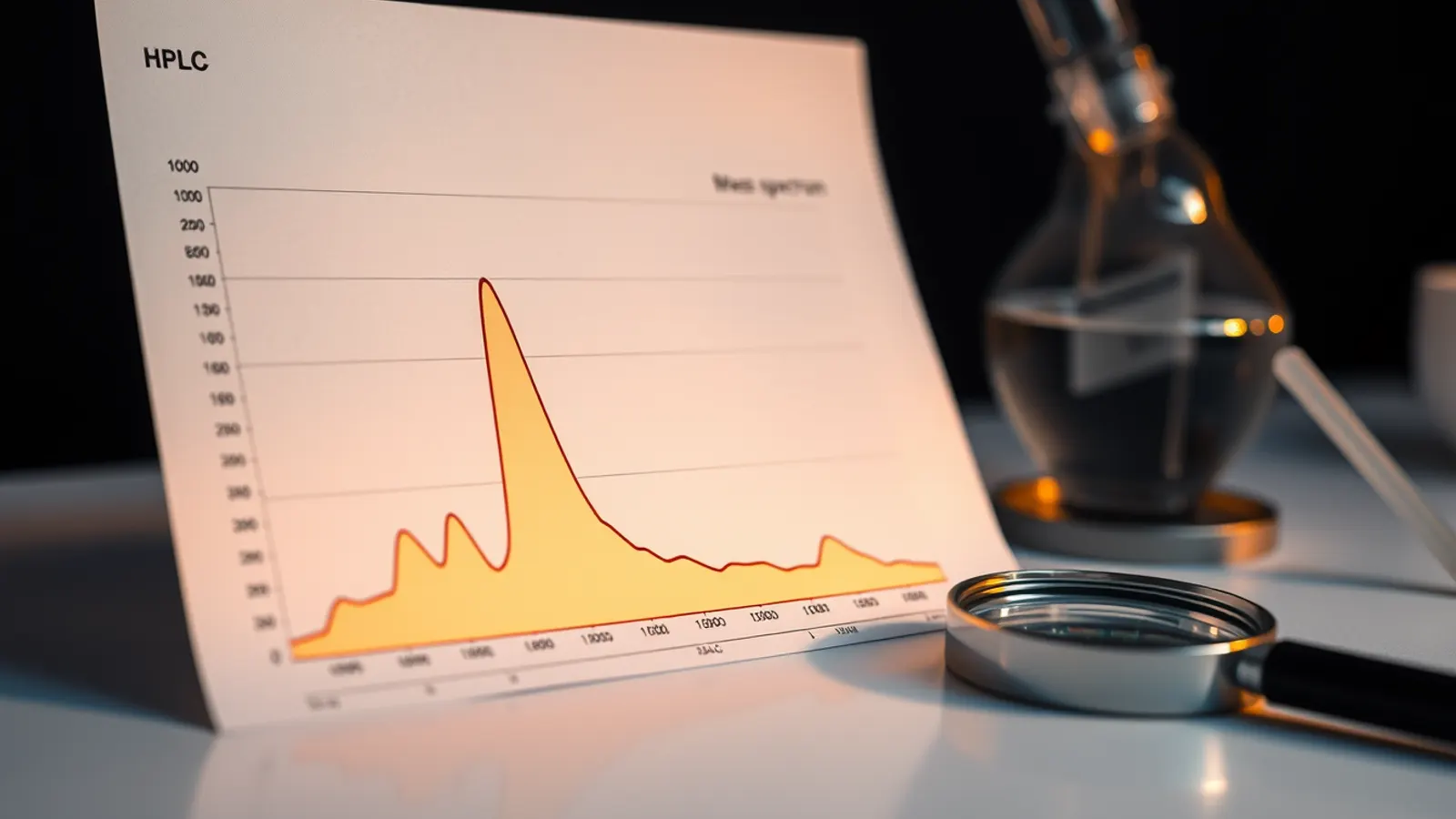
HPLC pushes a dissolved sample through a packed column. Different components leave the column at different times, and a detector, usually UV absorbance in the low-UV range where peptide bonds absorb, records them as peaks. A real chromatogram has recognisable features:
- Axes with units. Retention time in minutes on the x-axis and detector response (often mAU) on the y-axis.
- A main peak and small neighbours. Synthetic peptides almost always show minor impurity peaks: deletion sequences, truncations or oxidised forms. A trace with one perfect spike and an absolutely flat baseline should prompt questions.
- Baseline noise and drift. Real detectors are slightly noisy. Gradient methods often show gentle baseline drift.
- An integration table. Each peak is listed with retention time, area and area percentage. The purity figure on the certificate should be the main peak's area percentage from this table, not a number typed in a header.
- Method details. Column type and dimensions, mobile phases, gradient, flow rate, detection wavelength and run time. Without a method, the number cannot be reproduced.
What a genuine mass spectrum looks like
Mass spectrometry confirms that the main component has the expected molecular mass. Compare the observed mass with the theoretical mass calculated from the sequence. With electrospray ionisation, a peptide usually appears as several charge states, such as [M+H]+ and [M+2H]2+, and the deconvoluted mass should agree across them. A genuine spectrum shows isotope patterns, some background ions and the instrument's own labelling. A certificate that simply prints "MS: conforms" with no spectrum, or lists only the theoretical mass, has not shown you an identity test.
Take BPC-157 as an example. It is a 15-amino-acid synthetic peptide (Vasireddi et al., 2025), so its mass spectrum should show a molecular mass consistent with that full sequence, and a truncated impurity would appear at a lower mass. GHK-Cu is the copper(II) complex of the tripeptide glycyl-histidyl-lysine (Pickart et al., 1973), so its identity data must account for both the peptide and the bound copper. For background on that compound, see GHK-Cu research: what the studies show.
Signs of a fabricated or recycled certificate
Template PDFs
Many fake certificates come from the same template: identical layout, fonts and wording across different "labs". Open the document properties. A report generated by a general-purpose PDF library or an office application, rather than exported from instrument or laboratory information software, is not proof of fraud on its own, but it deserves follow-up. Edited PDFs often show mismatched fonts, misaligned text boxes or numbers that sit slightly off the baseline of the surrounding text.
Missing or generic chromatogram
A purity number with no chromatogram is a claim, not a result. Watch also for chromatograms that look identical across different compounds or different lots: the same peak shape, the same noise, the same retention time. Real runs never repeat exactly.
Untraceable or newly created labs
Search for the testing lab independently, not through links in the certificate. Warning signs include no physical address, no named analysts or quality staff, no accreditation, a website domain registered only weeks or months before the certificate date, and a business registration that is very recent. A lab whose only visible output is certificates for peptide sellers is a particular concern.
The same numbers across lots
Purity, retention time and observed mass should vary slightly from lot to lot. Several "different" lots reporting identical figures to two decimal places suggests one certificate being reissued under new lot numbers.
Lot numbers that do not match the vial
The lot number on the certificate must match the lot printed on the vial label. A certificate with no lot number, a generic one such as a product code, or one that differs from the label does not describe the material you hold.
Approval timestamps that are too fast
Many lab reports show when a sample was received, when it was analysed and when the report was approved. An HPLC run plus mass spectrometry, data review and sign-off takes time. A report approved within seconds or minutes of sample receipt, or approved before analysis is recorded as complete, points to a document generated without a real review.
How to verify peptide purity and identity yourself
- Match the lot. Compare the lot number on the certificate with the vial label before anything else.
- Read the data, not the header. Find the chromatogram, the integration table and the mass spectrum, and check that the stated purity matches the table.
- Check the lab independently. Find its address, accreditation and contact details through your own search, then check any accreditation claim in the accrediting body's public directory, including whether peptide analysis is within the accredited scope.
- Ask the lab to confirm the report. Send the report number and lot to the lab's own contact address and ask whether they issued it. A genuine lab can answer.
- Compare across lots. If a seller shows several certificates, look for figures that are suspiciously identical.
- Consider independent testing. For important work, send a sample to a laboratory you choose yourself.
What separates a legit peptide vendor
A legit peptide vendor makes verification easy. The certificate is available before purchase, it is specific to the lot you will receive, it includes the chromatogram and the mass spectrum, and it names a lab you can contact. California Standard publishes each lot's certificate before you pay, and each certificate states that lot's measured purity and identity. We would rather you check than trust us.
| COA element | Genuine | Red flag |
|---|---|---|
| Lot number | Matches the vial label | Missing, generic or different |
| HPLC | Chromatogram, integration table, method | Purity number only |
| Mass spectrum | Observed vs theoretical mass, spectrum shown | "Conforms" with no data |
| Laboratory | Traceable address, accreditation, contactable | New domain, no address, unverifiable |
| Timestamps | Plausible gaps between receipt, analysis and approval | Approved within minutes of receipt |
| Across lots | Small, natural variation | Identical figures |
The same checks apply to every compound in the catalogue, from bioregulators (bioregulator peptides research) to Selank and Semax.
Frequently asked questions
How can I tell if a peptide COA is fake?
Check that the lot number matches the vial, that a real chromatogram, integration table and mass spectrum are present, that the testing lab is traceable and contactable, that figures vary naturally between lots and that approval timestamps are plausible. Then ask the lab directly whether it issued the report.
Is a purity number alone enough?
No. Purity is meaningful only alongside the chromatogram and integration table it came from, and it says nothing about identity. Identity needs a mass spectrum compared against the theoretical mass of the sequence.
Why do real chromatograms show small extra peaks?
Peptide synthesis produces minor related impurities such as deletion or truncated sequences. A real chromatogram shows these as small peaks and lists them in the integration table. A perfectly clean trace with no baseline noise is more suspicious, not less.
What does a legit peptide vendor provide?
A lot-specific certificate available before purchase, with HPLC and mass-spec data and a named, contactable laboratory.
See it in the catalogue: BPC-157 with its lot certificate.
For laboratory research use only. Products sold by California Standard Peptides are not drugs, foods, supplements or cosmetics and are not for human or veterinary use. This article summarises published literature; it is not medical advice and not a usage guide.