Bioregulator Peptides: What the Research on Pinealon, Epitalon and Testagen Shows
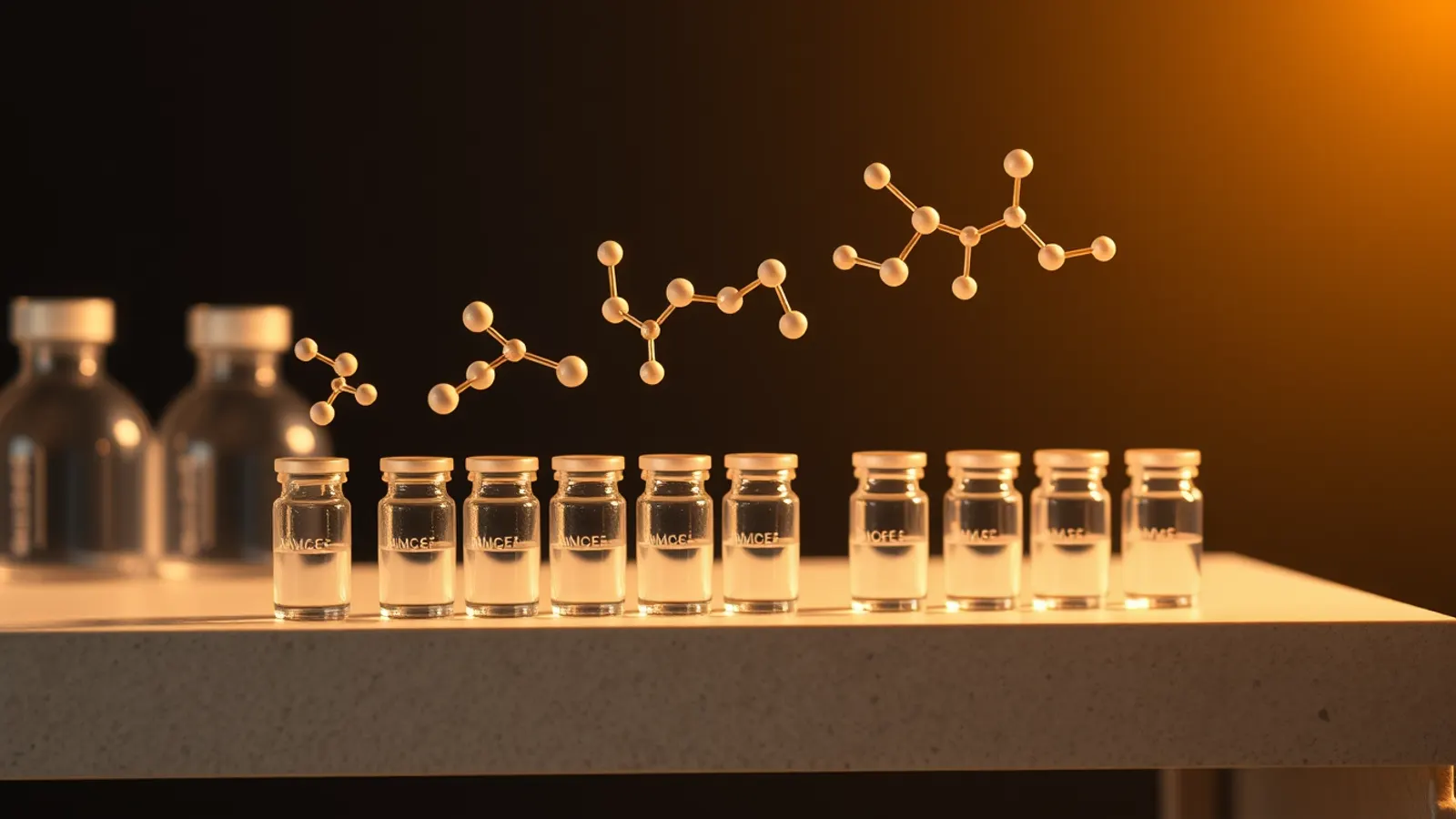
Bioregulator peptides are very short synthetic peptides, typically two to four amino acids, along with one thymus extract. Names such as the Pinealon peptide, Epitalon and Testagen attract a lot of search interest. The literature behind them is large in count but narrow in origin: most of it comes from the St. Petersburg Institute of Bioregulation and Gerontology group associated with Vladimir Khavinson and its collaborators, and most of it has not been independently replicated. This review covers what is reported for each compound and how much weight that evidence can bear.
What "Khavinson peptides" are
"Khavinson peptides" is the informal name for this family. The group's central idea is that short peptides, often designed from the amino acid composition of animal tissue extracts, act in a tissue-specific way and may enter cells and interact with DNA or histones to change gene expression. That proposal is worth reading closely. In the group's own 2020 review it is worded as an assumption, and much of the support for direct DNA binding comes from computer docking and molecular modelling rather than experiments that show the binding happening in cells (Khavinson et al., 2020).
Why the evidence base needs care
- One research group. For Pinealon, Vesugen and Vilon, the records we reviewed come almost entirely from the St. Petersburg institute and its collaborators. Independent replication is largely missing.
- Language and access. Many papers appear only in Russian-language journals, with abstracts in English. Methods and blinding often cannot be assessed from the abstract.
- Study models. Most findings are in cultured cells, rat tissue, mice or, for Testagen, chickens. Human reports are small and often uncontrolled before-and-after comparisons.
- No registered trials. ClinicalTrials.gov searches for Pinealon, Vesugen, Vilon and Thymalin returned no studies, and no FDA-approved product was found for any of them.
None of this means the findings are wrong. It means they are unconfirmed, and a careful reader treats them as hypotheses.
The Pinealon peptide (Glu-Asp-Arg)
Pinealon is the synthetic tripeptide Glu-Asp-Arg (EDR). In cerebellar granule cells, neutrophils and PC12 cells, it was reported to restrict the build-up of reactive oxygen species, reduce necrotic cell death and delay ERK 1/2 activation (Khavinson et al., 2011). In the offspring of rats with experimentally induced hyperhomocysteinemia, it was associated with lower reactive oxygen species and fewer necrotic cells (Arutjunyan et al., 2012). The 2020 review describes reduced loss of dendritic spines in neuronal cultures from mouse models of Alzheimer's and Huntington's disease.
Human data are small Russian-language reports. One study of 32 people given Vesugen or Pinealon has an abstract whose own numbers do not add up (Meshchaninov et al., 2015). That is the level of detail available, and it is not enough to draw conclusions.
Epitalon (Ala-Glu-Asp-Gly)
Epitalon, also spelled Epithalon, is the tetrapeptide Ala-Glu-Asp-Gly (AEDG), modelled on the amino acid composition of epithalamin, a bovine pineal extract. Its mechanism is not established. In one cell-culture study it was associated with telomerase activity and telomere elongation in human fetal fibroblasts (Khavinson et al., 2003).
The mouse lifespan data are often over-summarised. In female SHR mice, Epitalon produced no change in mean lifespan; the reported difference was longer survival of the oldest animals (Anisimov et al., 2003). An independent 2025 review notes that the evidence is in vitro, in vivo and in silico, and that it is unclear whether reported effects on melatonin synthesis and several enzymes explain its actions (Araj et al., 2025). Controlled human trials of Epitalon are lacking.
Testagen (Lys-Glu-Asp-Gly)
Testagen is the name some papers use for the tetrapeptide Lys-Glu-Asp-Gly (KEDG). Other papers on the same sequence describe it as designed from anterior pituitary extracts. The literature under this name is very small. In HeLa cells, fluorescently labelled peptide appeared in the cytoplasm, nucleus and nucleolus, and test-tube experiments showed sequence-dependent binding to short DNA fragments (Fedoreyeva et al., 2011). In neonatally hypophysectomised chickens, KEDG was studied for effects on thyroid structure and function (Kuznik et al., 2008), and a review by the originating group lists it among peptides reported to influence immune-cell differentiation (Khavinson et al., 2020).
Where the evidence stops: none of the sources we reviewed reports work on testicular tissue or any human study of this peptide, despite what the name suggests. The name also collides with an unrelated product brand, so searches for it need care.
Vesugen, Vilon and Thymalin
Vesugen (Lys-Glu-Asp)
The group describes the tripeptide KED as a vascular peptide. Cell studies report changes in markers such as Ki-67, nestin and GAP43 (Khavinson et al., 2021). A 2024 study in fibroblast-derived induced neurons found more dendrite branching but no effect on mitochondria, lysosomes or p16 (Kraskovskaya et al., 2024). Human data are small Russian before-and-after studies, including one of 41 patients (Kitachev et al., 2014).
Vilon (Lys-Glu)
The dipeptide KE has been studied for thymocyte proliferation and sphingomyelinase activity in mouse cells (Khavinson et al., 2002), for loosening of condensed chromatin in cultured lymphocytes from older donors (Lezhava et al., 2004), and for lower TNF and IL-6 expression in the THP-1 monocyte cell line, a study with Italian co-authors (Avolio et al., 2022). A single-group mouse lifespan study is also reported (Khavinson et al., 2000).
Thymalin (calf thymus extract)
Thymalin is not a single defined peptide. It is a polypeptide complex extracted from calf thymus, with components up to about 10 kDa, and the dipeptides Lys-Glu and Glu-Trp are described as active constituents (Linkova et al., 2023). In culture it shifted hematopoietic stem-cell markers toward mature T-lymphocyte markers, and its developers state that the molecular mechanism requires further study (Khavinson et al., 2020). Its developers also report that it has been registered in Russia as an immunomodulator since 1982, and describe a single-centre, open-label COVID-19 study of 92 patients (Khavinson et al., 2021). These statements come from the developers and concern the registered Russian product.
Specification summary
| Product | Sequence or composition | Main study models | Storage |
|---|---|---|---|
| Pinealon | Glu-Asp-Arg (EDR) | Cultured cells, rats | -20 °C, desiccated |
| Epitalon | Ala-Glu-Asp-Gly (AEDG) | Cultured cells, mice | -20 °C, desiccated |
| Testagen | Lys-Glu-Asp-Gly (KEDG) | HeLa cells, test tube, chickens | -20 °C, desiccated |
| Vesugen | Lys-Glu-Asp (KED) | Cultured cells | -20 °C, desiccated |
| Vilon | Lys-Glu (KE) | Mouse cells, cultured lymphocytes, cell lines | -20 °C, desiccated |
| Thymalin | Calf thymus polypeptide complex | Cultured stem cells, blood cells | -20 °C, desiccated |
Characterising very short peptides
Short peptides raise a specific analytical point. Pinealon and Vesugen differ by one residue, Epitalon and Testagen share three of four, and Vilon is only two amino acids long. Sequence-level identity therefore matters as much as purity. Each lot's certificate states the measured purity from HPLC and confirms identity by mass spectrometry against the theoretical mass of the named sequence. Thymalin is different again: as an extract it has no single theoretical mass, so its characterisation reads differently from a defined synthetic peptide. Our guide to spotting a fake peptide COA explains what to look for in both the chromatogram and the mass spectrum.
Catalogue links: Pinealon, Epitalon and Testagen. Compounds often grouped with these online, such as SS-31 and MOTS-c, have a very different evidence profile; see SS-31 and MOTS-c research.
Frequently asked questions
What are Khavinson peptides?
It is an informal name for short bioregulator peptides developed and studied mainly by Vladimir Khavinson's St. Petersburg group and its collaborators, including Pinealon, Epitalon, Vesugen, Vilon and Testagen, along with the thymus extract Thymalin.
Has the research on bioregulator peptides been independently replicated?
Mostly not. For several of these peptides, nearly all published records come from one group and its collaborators, many in Russian-language journals. A few papers have outside co-authors, and an independent 2025 review of Epitalon describes its mechanism as uncertain.
Is the Pinealon peptide the same as Epitalon?
No. Pinealon is the tripeptide Glu-Asp-Arg; Epitalon is the tetrapeptide Ala-Glu-Asp-Gly. They are often discussed together because both are linked to pineal research by the same group.
Has Testagen been studied in testicular tissue?
Not in the sources we reviewed. The published work under this name is cell, test-tube and bird studies, and we found no human study of the peptide.
See it in the catalogue: Epitalon research peptide.
For laboratory research use only. Products sold by California Standard Peptides are not drugs, foods, supplements or cosmetics and are not for human or veterinary use. This article summarises published literature; it is not medical advice and not a usage guide.