Net Peptide Content vs Purity: Two Numbers That Measure Different Things
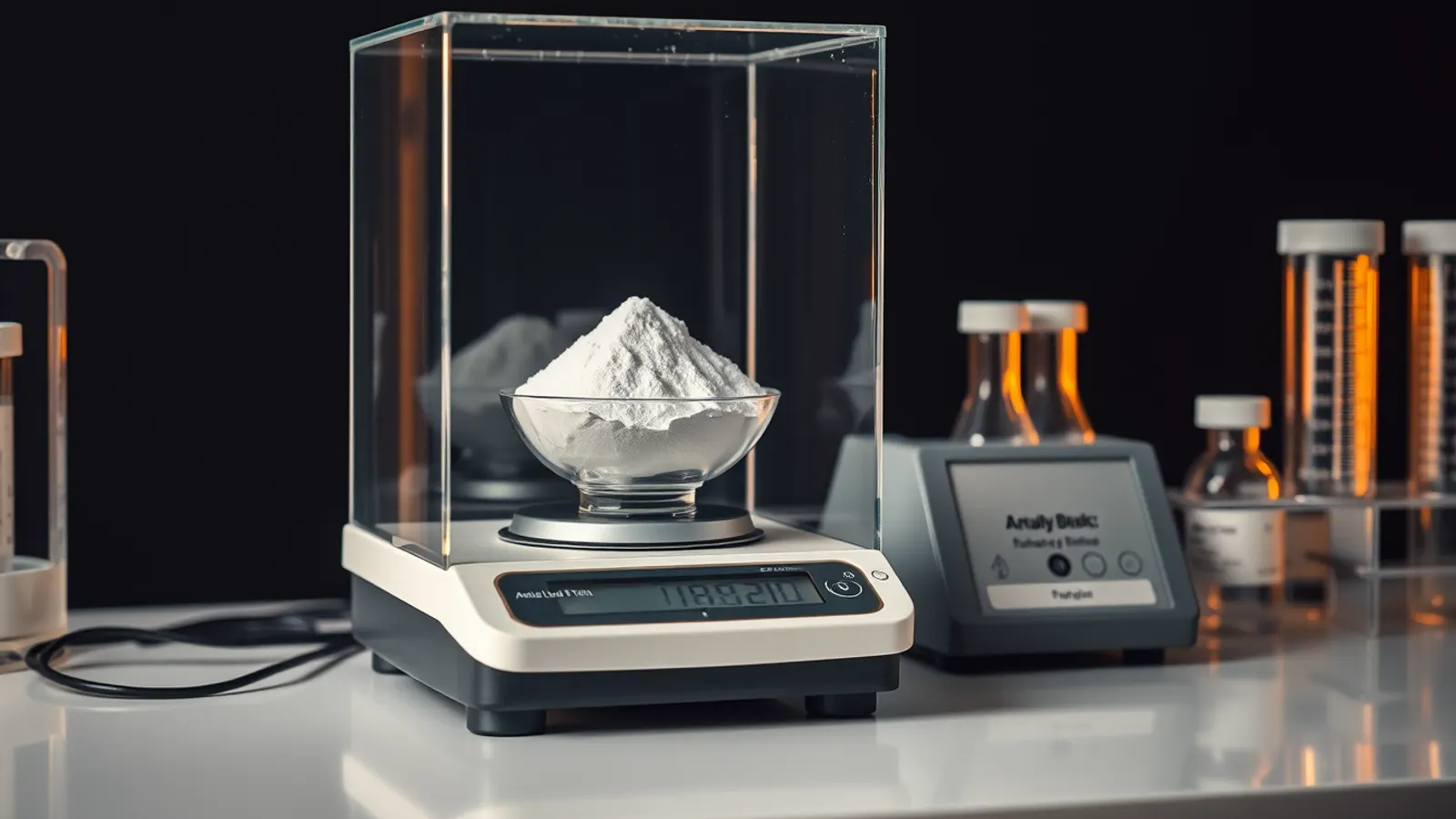
Net peptide content vs purity is one of the most common points of confusion on a research-peptide certificate. Both numbers describe the same lot and both can be expressed as fractions of a whole, so they are easy to mix up. They measure different things. Purity, usually from HPLC, describes how much of the peptide-related material is the target sequence. Net peptide content describes how much of the weighed powder is peptide at all, as opposed to counterions, water and other non-peptide material. This guide explains where each number comes from and why a careful researcher wants both.
What is in a vial of lyophilised peptide
A freeze-dried peptide looks like a uniform white cake or powder, but chemically it is a mixture. Typical components are:
- The target peptide, the sequence you intended to obtain.
- Peptide-related impurities: deletion and truncated sequences, oxidised or deamidated forms and other by-products of synthesis and storage.
- Counterions: negatively charged ions such as trifluoroacetate, acetate or chloride, paired with the peptide's positively charged groups.
- Water, bound to the peptide and its salts even after freeze-drying.
- Trace residual solvents from synthesis and purification.
Purity and net peptide content each look at a different slice of that mixture.
Purity: a ratio among peptides
HPLC purity is the main peak's share of the total peak area in a UV chromatogram, normally recorded in the low-UV range where peptide bonds absorb. Counterions and water absorb little or nothing there, so they do not appear in the calculation. The result is a ratio among the UV-visible components, which in practice means among the peptide and its related impurities. Our article on HPLC peptide purity explains the method and its limits.
A high purity figure tells you the peptide fraction is clean. It does not tell you how large that peptide fraction is relative to everything else in the vial.
Net peptide content: a ratio by weight
Net peptide content (NPC) is the mass of peptide divided by the total mass of the powder. It answers a gravimetric question: if you weigh out a quantity of this powder, what share of that weight is peptide? For salt-form peptides, NPC is always meaningfully below the whole, because counterions and water have mass even though HPLC cannot see them.
The two numbers combine. The amount of target sequence in a sample is, approximately, the powder mass multiplied by the net peptide content and then by the purity. A lot can have excellent purity and modest net peptide content, or the reverse, and both situations are chemically normal.
Where the counterions come from
Most research peptides are made by solid-phase synthesis, the stepwise method introduced by Merrifield, 1963. Trifluoroacetic acid (TFA) is commonly used in the final processing of synthetic peptides, and purification by preparative reversed-phase HPLC typically uses TFA in the mobile phase as well. When the purified fractions are freeze-dried, the peptide's basic groups (the N-terminal amine and the side chains of lysine, arginine and histidine) leave the process as trifluoroacetate salts.
Two consequences follow:
- More basic residues means more counterion. A sequence rich in lysine and arginine carries more trifluoroacetate per molecule than a neutral or acidic one, so its NPC tends to be lower.
- Salt form is a choice. Laboratories can exchange trifluoroacetate for acetate or chloride by ion exchange or repeated lyophilisation from a different acid. Acetate is lighter than trifluoroacetate, so the same peptide as an acetate salt generally has a higher NPC. Some research protocols prefer acetate or chloride because residual TFA can interfere with certain cell-based assays.
Where the water comes from
Peptides are hygroscopic. Polar backbones and charged side chains bind water, and freeze-drying removes free water far more effectively than tightly bound water. A vial opened in humid air can also pick up moisture quickly. Water content therefore varies from lot to lot and changes with handling, which is one reason storage advice emphasises closed containers and avoiding condensation. Moisture also matters chemically, as discussed in peptide stability and degradation.
How net peptide content is measured
Because the peptide is the part being quantified, NPC methods measure something that belongs only to the peptide:
- Amino acid analysis (AAA). A weighed sample is hydrolysed in strong acid, breaking it into free amino acids, which are then separated and quantified against standards. Knowing the sequence, the laboratory back-calculates the mass of intact peptide. AAA is widely regarded as the reference approach, though some residues (tryptophan, cysteine) are partly destroyed by standard hydrolysis and need special handling.
- Elemental nitrogen analysis. Combustion analysis measures total nitrogen in a weighed sample. Because the peptide's nitrogen content is known from its formula, and common counterions such as trifluoroacetate and acetate contain no nitrogen, peptide mass can be estimated. Nitrogen-containing impurities or salts can bias the result.
- Quantitative UV or NMR against a reference, used in some laboratories for specific sequences.
The non-peptide parts can be measured directly as a cross-check: water by the Karl Fischer method, trifluoroacetate or acetate by ion chromatography (or fluorine NMR for trifluoroacetate). In a well-characterised lot, peptide, counterion and water should account for close to the whole of the mass. Regulatory method guidance such as the FDA's Q2(R2) Validation of Analytical Procedures describes the accuracy and precision checks that apply to any such quantitative assay.
Gross weight and net weight on a label
NPC also explains why the stated quantity on a vial needs a convention. A fill weight can refer to the gross weight of powder, which includes counterions and water, or to the net amount of peptide. The two can differ substantially for the same vial. Neither is wrong, but a researcher calculating concentrations for an in-vitro experiment needs to know which one applies. A complete certificate makes the basis explicit, and when NPC is reported it lets a laboratory work from the actual peptide mass.
Purity and net peptide content side by side
| HPLC purity | Net peptide content | |
|---|---|---|
| Question answered | How much of the peptide material is the target sequence? | How much of the powder's weight is peptide? |
| Basis | UV peak areas | Mass |
| Typical method | Reversed-phase HPLC at low UV | Amino acid analysis or nitrogen analysis |
| Sees counterions and water? | No | Yes, by difference |
| Main influences | Synthesis quality, purification, degradation | Salt form, number of basic residues, moisture |
| Confirms identity? | No | No; identity needs mass spectrometry |
What to look for on a certificate
A useful certificate states purity with its chromatogram and method, identity with a mass spectrum, and either the net peptide content or at least the salt form and the basis of the fill weight. Longer sequences with many basic residues, such as thymosin alpha-1, are where the gap between gross and net weight tends to be widest. If a supplier quotes a single number and calls it both "purity" and "content", ask which measurement it is. Our guide on how to spot a fake peptide COA covers the wider set of checks.
At California Standard, each lot's certificate states its measured purity and identity and is available before you pay, so you can see exactly which measurements stand behind the label.
Frequently asked questions
What is the difference between net peptide content and purity?
Purity, by HPLC, is the share of the peptide-related material that is the target sequence. Net peptide content is the share of the total powder mass that is peptide, with counterions and water making up much of the rest.
Why is net peptide content lower than purity?
Because HPLC cannot see counterions or water, while a weight-based measurement includes them. A salt-form peptide always carries counterions, and freeze-dried powders always retain some water.
What is a TFA salt peptide?
A peptide whose basic groups are paired with trifluoroacetate, which usually comes from the acid used to cleave the peptide from the synthesis resin and from HPLC purification. It can be exchanged for acetate or chloride.
How is net peptide content measured?
Most often by amino acid analysis after acid hydrolysis, or by elemental nitrogen analysis, sometimes cross-checked with Karl Fischer water measurement and ion chromatography for counterions.
See it in the catalogue: BPC-157 with its lot certificate.
For laboratory research use only. Products sold by California Standard Peptides are not drugs, foods, supplements or cosmetics and are not for human or veterinary use. This article summarises published literature; it is not medical advice and not a usage guide.