
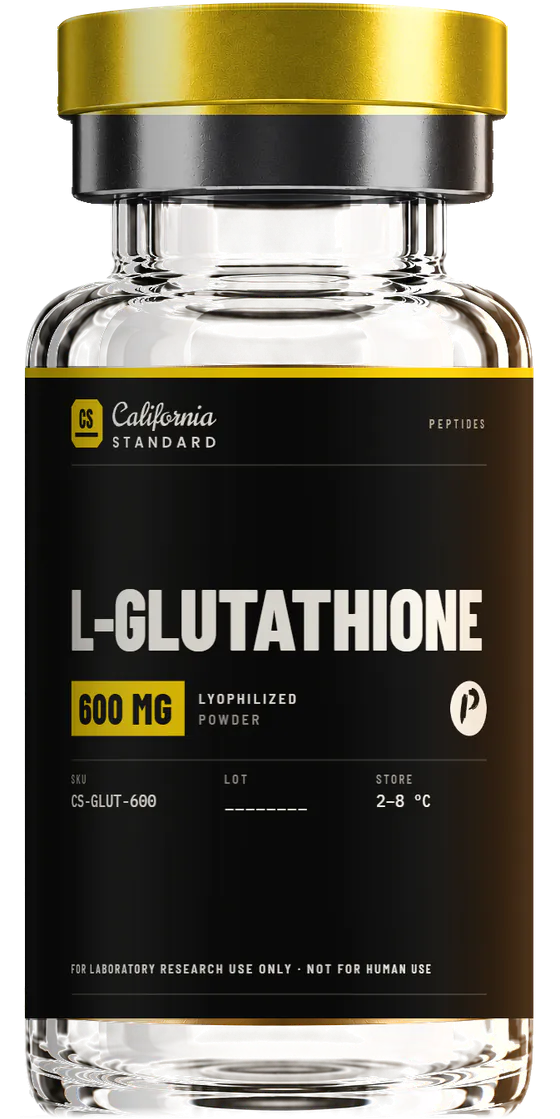
Research peptides
L-Glutathione
Glutathione is a tripeptide, gamma-L-glutamyl-L-cysteinylglycine, present in all mammalian tissues as the most abundant non-protein thiol. It exists in a reduced form (GSH) and an oxidized disulfide form (GSSG).
- Container
- Glass vial, crimp seal, flip-top cap
- Storage
- 2 to 8 °C, desiccated
- Paperwork
- Lot certificate (HPLC + mass spec) shown before you pay
Lot certificates
You’ll see American Peptides on the lab’s copy. They’re our supplier.
- 600 mg, lot LGLU600-0528: 99.90% purity (RP-HPLC), 602.43 mg measured, identity confirmed by mass spec. Issued 2026-06-17 by Bioviridian Inc.. Verify certificate COA4841
- 1500 mg, lot GLU1500-0803: 99.76% purity (RP-HPLC), 1505.41 mg measured, identity confirmed by mass spec. Issued 2026-08-28 by Bioviridian Inc.. Verify certificate COA7597
Our vials are filled from lots made by our supplier, American Peptides, and tested by Bioviridian Inc.The laboratory’s original certificate lists American Peptides as the vendor. Look up the code at bioviridians.com to check it.
What researchers study it for
- Oxidative stress and redox signaling
- Regulation of glutathione synthesis
- Oral supplementation and body stores
- Skin pigmentation
- Liver disease and fibrosis
How it is thought to work
The core biochemistry is well established. Glutathione is made in the cytosol in two enzymatic steps, with glutamate cysteine ligase as the rate-limiting enzyme and cysteine availability as a key determinant. Its antioxidant function runs largely through glutathione peroxidase reactions that oxidize GSH to GSSG, which is then reduced back at the expense of NADPH.
Where the research stands
Human trials exist; findings mixed. A six-month randomized trial in 54 adults reported higher blood glutathione with oral supplementation. Systematic reviews of skin-color studies describe the evidence as inconclusive, with mixed study quality. It is commonly sold as a dietary supplement.
Sources
- Lu SC. (2013). Glutathione synthesis. Biochimica et Biophysica Acta.
- Richie JP Jr, et al. (2015). Randomized controlled trial of oral glutathione supplementation on body stores of glutathione. European Journal of Nutrition.
- Dilokthornsakul W, et al. (2019). The clinical effect of glutathione on skin color and other related skin conditions: A systematic review. Journal of Cosmetic Dermatology.
- Sarkar R, et al. (2025). Glutathione as a skin-lightening agent and in melasma: a systematic review. International Journal of Dermatology.
Read more
For laboratory research use only. Not a drug, food, supplement or cosmetic; not for human or veterinary use. Nothing on this page is medical advice or a usage guide.