
Hormones
Sermorelin
Sermorelin is a synthetic 29-amino-acid analog of human growth hormone-releasing hormone (GHRH), the shortest fragment reported to retain full GHRH activity.
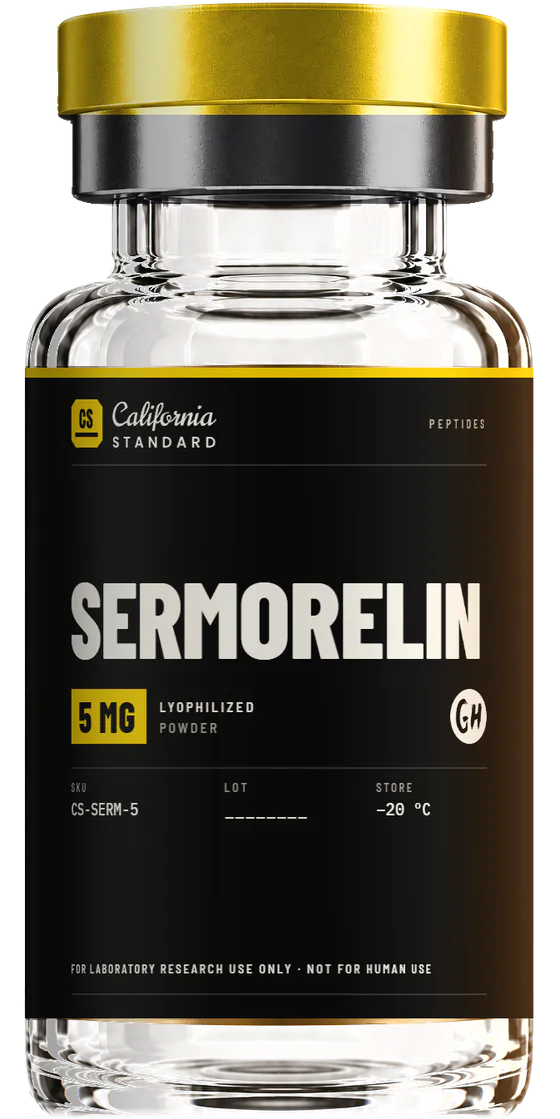
- Container
- Glass vial, crimp seal, flip-top cap
- Storage
- -20 °C, desiccated
- Paperwork
- Lot certificate (HPLC + mass spec) shown before you pay
Lot certificates
You’ll see American Peptides on the lab’s copy. They’re our supplier.
- 5 mg, lot SERMO5-0318: 99.80% purity (RP-HPLC), 6.36 mg measured, identity confirmed by mass spec. Issued 2026-04-03 by Bioviridian Inc.. Verify certificate COA3372
Our vials are filled from lots made by our supplier, American Peptides, and tested by Bioviridian Inc.The laboratory’s original certificate lists American Peptides as the vendor. Look up the code at bioviridians.com to check it.
What researchers study it for
- Diagnostic testing of pituitary GH secretion
- Pediatric idiopathic growth hormone deficiency
- GH pulse regulation studies
How it is thought to work
Sermorelin acts on GHRH receptors in the anterior pituitary and specifically stimulates growth hormone secretion. Researchers have also used it to examine how GHRH and somatostatin, the hormone that inhibits GH release, interact to shape GH pulses.
Where the research stands
Formerly FDA-approved (Geref). Marketed in the US as Geref (approved 1990 and 1997), it was discontinued by EMD Serono with approval withdrawn in 2009, and FDA determined in 2013 this was not for safety or effectiveness reasons.
Sources
- Prakash A, Goa KL (1999). Sermorelin: a review of its use in the diagnosis and treatment of children with idiopathic growth hormone deficiency.. BioDrugs.
- Food and Drug Administration, HHS (2013). Determination That GEREF (Sermorelin Acetate) Injection, 0.5 Milligrams Base/Vial and 1.0 Milligrams Base/Vial, and GEREF (Sermorelin Acetate) Injection, 0.05 Milligrams Base/Amp, Were Not Withdrawn From Sale for Reasons of Safety or Effectiveness (78 FR 14095, Docket FDA-2012-P-1071). Federal Register.
- Achermann JC, Hindmarsh PC, Robinson IC, Matthews DR, et al. (1999). The relative roles of continuous growth hormone-releasing hormone (GHRH(1-29)NH2) and intermittent somatostatin(1-14)(SS) in growth hormone (GH) pulse generation: studies in normal and post cranial irradiated individuals.. Clin Endocrinol (Oxf).
- Dominikowski A, Rękoś Z, Olejarz M, Szczepanek-Parulska E, Domin R, Ruchała M (2026). The emerging landscape of performance-enhancing peptides modulating GH-IGF1 axis: bridging the gap between clinical evidence and patient self-administration.. Front Endocrinol (Lausanne).
For laboratory research use only. Not a drug, food, supplement or cosmetic; not for human or veterinary use. Nothing on this page is medical advice or a usage guide.