
Hormones
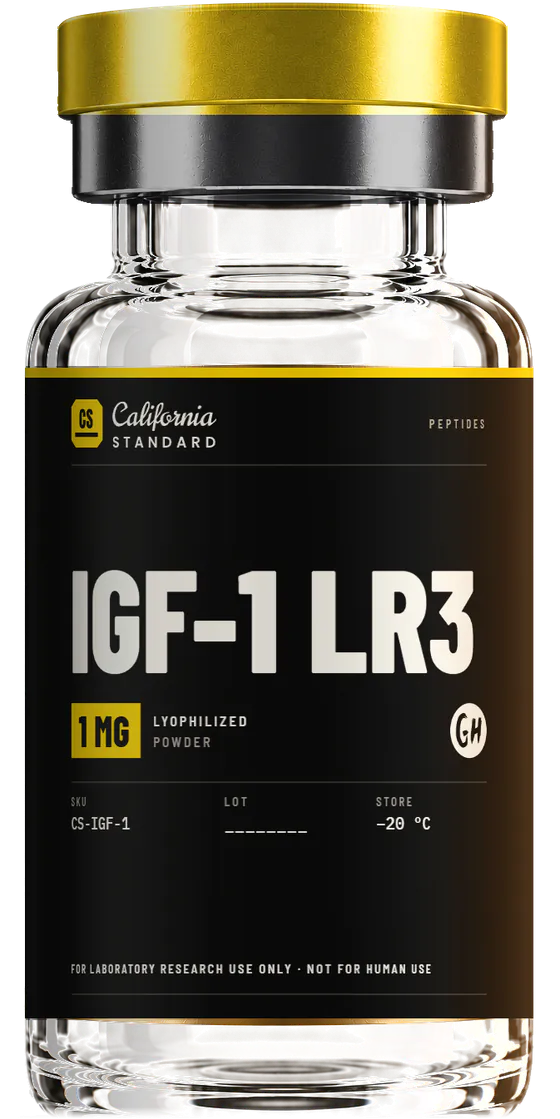
IGF-1 LR3
IGF-1 LR3 (Long [Arg3]-IGF-I) is a recombinant analogue of human insulin-like growth factor 1 in which arginine replaces glutamate at position 3 and a short peptide extension is added at the N-terminus. It was described in 1992 as a reagent for studying IGF-I action.
- Container
- Glass vial, crimp seal, flip-top cap
- Storage
- -20 °C, desiccated
- Paperwork
- Lot certificate (HPLC + mass spec) shown before you pay
Lot certificates
You’ll see American Peptides on the lab’s copy. They’re our supplier.
- 1 mg, lot IGF1-0803: 99.55% purity (RP-HPLC), 1.12 mg measured, identity confirmed by mass spec. Issued 2026-08-28 by Bioviridian Inc.. Verify certificate COA7588
Our vials are filled from lots made by our supplier, American Peptides, and tested by Bioviridian Inc.The laboratory’s original certificate lists American Peptides as the vendor. Look up the code at bioviridians.com to check it.
What researchers study it for
- IGF-binding protein interactions
- Muscle cell growth in culture
- Growth in diabetic rat models
- Fetal growth in sheep
How it is thought to work
It acts through the IGF-1 receptor, like native IGF-1. The original cell studies attributed its greater potency in culture to much weaker binding to IGF-binding proteins, which normally regulate IGF-1 availability. Animal findings are mixed: it restored growth in diabetic rats, but did not improve growth in growth-restricted fetal sheep.
Where the research stands
Preclinical research and laboratory reagent. A 2026 narrative review found no peer-reviewed human studies of IGF-1 LR3, and a search of ClinicalTrials.gov returned no registered trials.
Sources
- Francis GL, et al. (1992). Novel recombinant fusion protein analogues of insulin-like growth factor (IGF)-I indicate the relative importance of IGF-binding protein and receptor binding for enhanced biological potency. Journal of Molecular Endocrinology.
- Tomas FM, et al. (1993). Insulin-like growth factor-I and more potent variants restore growth of diabetic rats without inducing all characteristic insulin effects. The Biochemical Journal.
- White A, et al. (2025). IGF-1 LR3 does not promote growth in late-gestation growth-restricted fetal sheep. American Journal of Physiology. Endocrinology and Metabolism.
- Dominikowski A, et al. (2026). The emerging landscape of performance-enhancing peptides modulating GH-IGF1 axis: bridging the gap between clinical evidence and patient self-administration. Frontiers in Endocrinology.
For laboratory research use only. Not a drug, food, supplement or cosmetic; not for human or veterinary use. Nothing on this page is medical advice or a usage guide.