
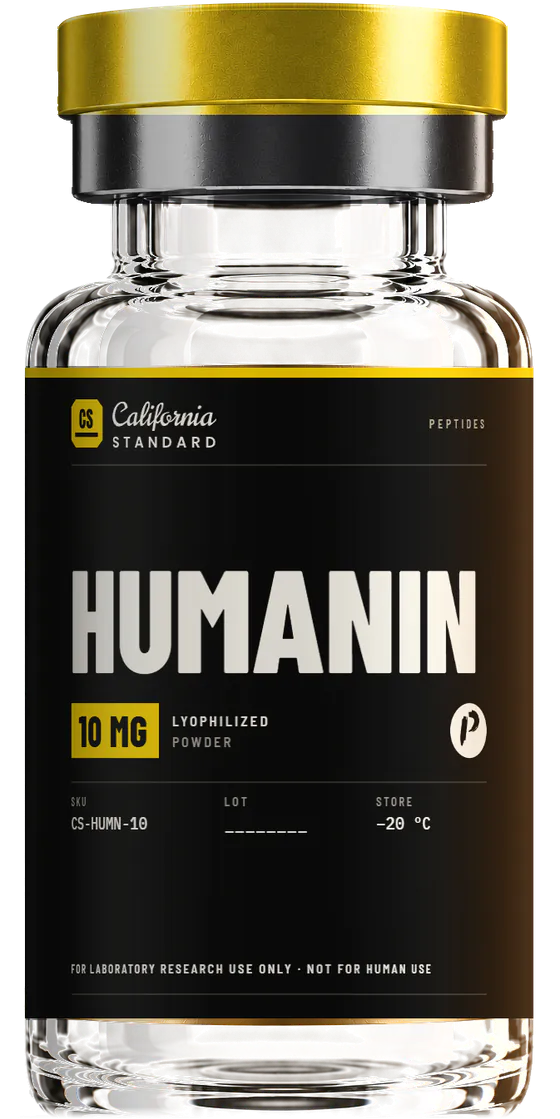
Research peptides
Humanin
Humanin is a 24-amino-acid peptide first reported in 2001, identified in a screen for factors that protected neuronal cells from Alzheimer's disease-related insults. It is classed as a mitochondrial-derived peptide, and an open reading frame for it is present in the mitochondrial genome.
- Container
- Glass vial, crimp seal, flip-top cap
- Storage
- -20 °C, desiccated
- Paperwork
- Lot certificate (HPLC + mass spec) shown before you pay
Lot certificates
You’ll see American Peptides on the lab’s copy. They’re our supplier.
- 10 mg, lot HUM10-0803: 99.79% purity (RP-HPLC), 10.60 mg measured, identity confirmed by mass spec. Issued 2026-08-28 by Bioviridian Inc.. Verify certificate COA7583
Our vials are filled from lots made by our supplier, American Peptides, and tested by Bioviridian Inc.The laboratory’s original certificate lists American Peptides as the vendor. Look up the code at bioviridians.com to check it.
What researchers study it for
- Alzheimer's disease cell and mouse models
- Apoptosis and cell survival
- Aging and age-related disease
- Circulating humanin as a biomarker
How it is thought to work
Several mechanisms have been proposed and none is settled. Inside cells, humanin was reported to bind the pro-apoptotic protein Bax and prevent its movement to mitochondria. At the cell surface, it was reported to act through a receptor complex involving CNTFR-alpha, WSX-1 and gp130. These findings come from cell and rodent experiments.
Where the research stands
Mainly preclinical research. ClinicalTrials.gov searches found only studies that measure humanin levels, and none that give the peptide to people. No approved product was found in Drugs@FDA.
Sources
- Hashimoto Y, et al. (2001). A rescue factor abolishing neuronal cell death by a wide spectrum of familial Alzheimer's disease genes and Abeta. Proceedings of the National Academy of Sciences of the United States of America.
- Guo B, et al. (2003). Humanin peptide suppresses apoptosis by interfering with Bax activation. Nature.
- Matsuoka M, Hashimoto Y. (2010). Humanin and the receptors for humanin. Molecular Neurobiology.
- Kim SJ, et al. (2021). Mitochondrial-derived peptides in aging and age-related diseases. GeroScience.
Read more
For laboratory research use only. Not a drug, food, supplement or cosmetic; not for human or veterinary use. Nothing on this page is medical advice or a usage guide.