
Blends
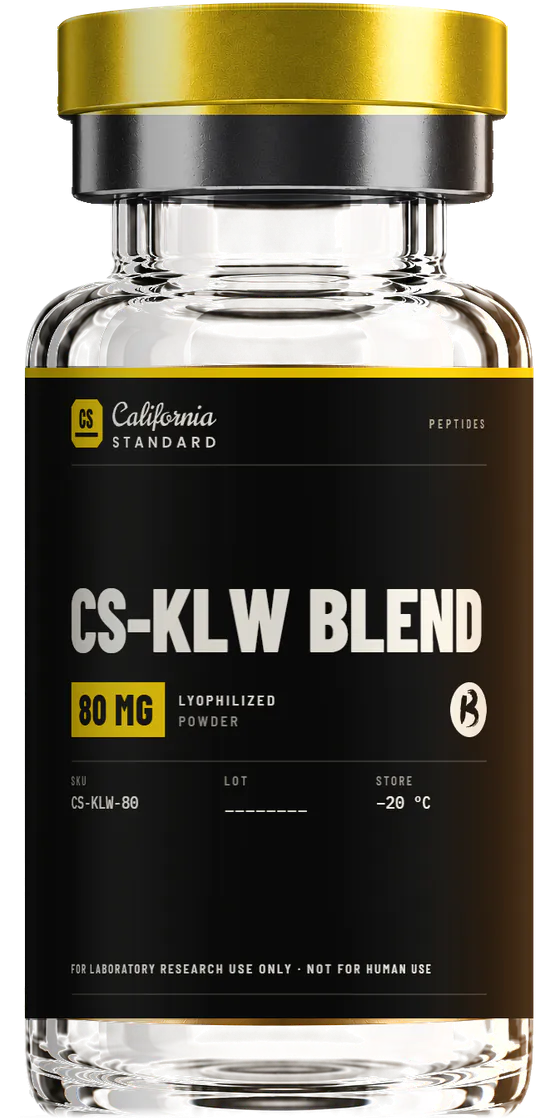
CS-KLW blend
A single vial containing GHK-Cu, BPC-157, TB-500 and KPV. The four compounds are studied separately; this listing summarises each component rather than any combined effect.
- Container
- Glass vial, crimp seal, flip-top cap
- Storage
- -20 °C, desiccated, protect from light
- In the vial
- GHK-Cu 50 mg + BPC-157 10 mg + TB-500 10 mg + KPV 10 mg
- Paperwork
- Lot certificate (HPLC + mass spec) shown before you pay
Lot certificates
You’ll see American Peptides on the lab’s copy. They’re our supplier.
- 80 mg, lot KLOW80-0713: 99.81% purity (RP-HPLC), 50.71 mg / 10.14 mg / 10.82 mg / 10.77 mg measured, identity confirmed by mass spec. Issued 2026-08-28 by Bioviridian Inc.. Verify certificate COA7577
Our vials are filled from lots made by our supplier, American Peptides, and tested by Bioviridian Inc.The laboratory’s original certificate lists American Peptides as the vendor. Look up the code at bioviridians.com to check it.
What researchers study it for
- Skin wound healing in animal models
- Collagen and extracellular matrix synthesis
- Tendon, ligament and muscle injury models
- Bone healing in animal models
- Anti-doping detection and metabolism
How it is thought to work
GHK-Cu: GHK binds copper(II), and the copper complex has been proposed as its active form. BPC-157: The mechanism is not well established. TB-500: Thymosin beta-4 is a 43-amino-acid actin-sequestering protein; its LKKTETQ region is the central actin-binding site and has been associated with cell migration and angiogenesis in laboratory studies. KPV: The mechanism is not well established.
Where the research stands
Blend of research compounds. Each component is studied separately; as a combined vial it has no dedicated published research. The least-established component is GHK-Cu: mostly preclinical research.
Sources
- Pickart L, Thaler MM. (1973). Tripeptide in human serum which prolongs survival of normal liver cells and stimulates growth in neoplastic liver. Nature New Biology.
- Pickart L, et al. (2015). GHK Peptide as a Natural Modulator of Multiple Cellular Pathways in Skin Regeneration. BioMed Research International.
- Vasireddi N, et al. (2025). Emerging Use of BPC-157 in Orthopaedic Sports Medicine: A Systematic Review. HSS Journal.
- McGuire FP, et al. (2025). Regeneration or Risk? A Narrative Review of BPC-157 for Musculoskeletal Healing. Current Reviews in Musculoskeletal Medicine.
- Esposito S, et al. (2012). Synthesis and characterization of the N-terminal acetylated 17-23 fragment of thymosin beta 4 identified in TB-500, a product suspected to possess doping potential. Drug Testing and Analysis.
- Ho EN, et al. (2012). Doping control analysis of TB-500, a synthetic version of an active region of thymosin β4, in equine urine and plasma by liquid chromatography-mass spectrometry. Journal of Chromatography A.
- Dalmasso G, et al. (2008). PepT1-mediated tripeptide KPV uptake reduces intestinal inflammation. Gastroenterology.
- Kannengiesser K, et al. (2008). Melanocortin-derived tripeptide KPV has anti-inflammatory potential in murine models of inflammatory bowel disease. Inflammatory Bowel Diseases.
Read more
For laboratory research use only. Not a drug, food, supplement or cosmetic; not for human or veterinary use. Nothing on this page is medical advice or a usage guide.