
Blends
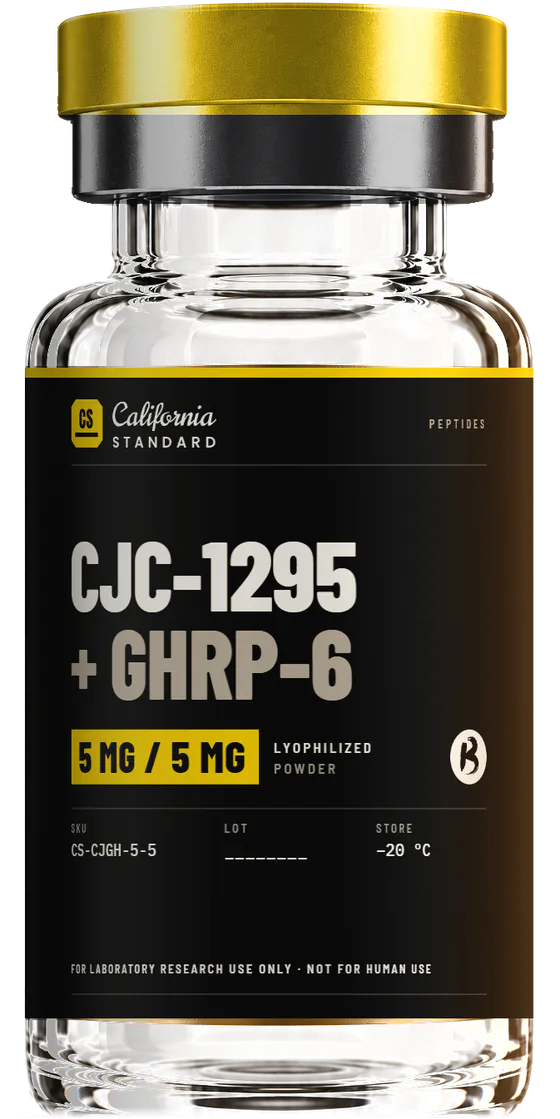
CJC-1295 + GHRP-6
A single vial containing CJC-1295 (no DAC) and GHRP-6. One is a GHRH-receptor agonist and the other a ghrelin-receptor agonist; published research examines them individually, not as this combination.
- Container
- Glass vial, crimp seal, flip-top cap
- Storage
- -20 °C, desiccated
- In the vial
- CJC-1295 (no DAC) + GHRP-6
- Paperwork
- Lot certificate (HPLC + mass spec) shown before you pay
Lot certificates
You’ll see American Peptides on the lab’s copy. They’re our supplier.
- 5 mg / 5 mg, lot CJCGHRP5-0528: 99.90% purity (RP-HPLC), 5.23 mg / 5.11 mg measured, identity confirmed by mass spec. Issued 2026-06-17 by Bioviridian Inc.. Verify certificate COA4860
Our vials are filled from lots made by our supplier, American Peptides, and tested by Bioviridian Inc.The laboratory’s original certificate lists American Peptides as the vendor. Look up the code at bioviridians.com to check it.
What researchers study it for
- Structural analog of GHRH(1-29)
- Doping-control detection in seized material
- Growth hormone release
- Pituitary reserve testing
How it is thought to work
CJC-1295 (no DAC): As a GHRH(1-29) analog, it is expected to act on the GHRH receptor of pituitary somatotrophs, but this is inferred from related compounds rather than measured directly. GHRP-6: GHRP-6 acts at the growth hormone secretagogue receptor (GHS-R1a), a G protein-coupled receptor of the pituitary and hypothalamus that was cloned in 1996 and is now known as the ghrelin receptor.
Where the research stands
Blend of research compounds. Each component is studied separately; as a combined vial it has no dedicated published research. The least-established component is CJC-1295 (no DAC): no published human studies.
Sources
- Jetté L, Léger R, Thibaudeau K, Benquet C, Robitaille M, Pellerin I, Paradis V, van Wyk P, Pham K, Bridon DP (2005). Human growth hormone-releasing factor (hGRF)1-29-albumin bioconjugates activate the GRF receptor on the anterior pituitary in rats: identification of CJC-1295 as a long-lasting GRF analog.. Endocrinology.
- Dominikowski A, Rękoś Z, Olejarz M, Szczepanek-Parulska E, Domin R, Ruchała M (2026). The emerging landscape of performance-enhancing peptides modulating GH-IGF1 axis: bridging the gap between clinical evidence and patient self-administration.. Front Endocrinol (Lausanne).
- Bowers CY, et al. (1984). On the in vitro and in vivo activity of a new synthetic hexapeptide that acts on the pituitary to specifically release growth hormone. Endocrinology.
- Howard AD, et al. (1996). A receptor in pituitary and hypothalamus that functions in growth hormone release. Science.
For laboratory research use only. Not a drug, food, supplement or cosmetic; not for human or veterinary use. Nothing on this page is medical advice or a usage guide.